On Friday 6 November 2026, we are pleased to organise an event at the Royal Swedish Academy of Sciences, exploring the opportunities offered by the Einstein Telescope — one of Europe’s most ambitious scientific infrastructure projects.
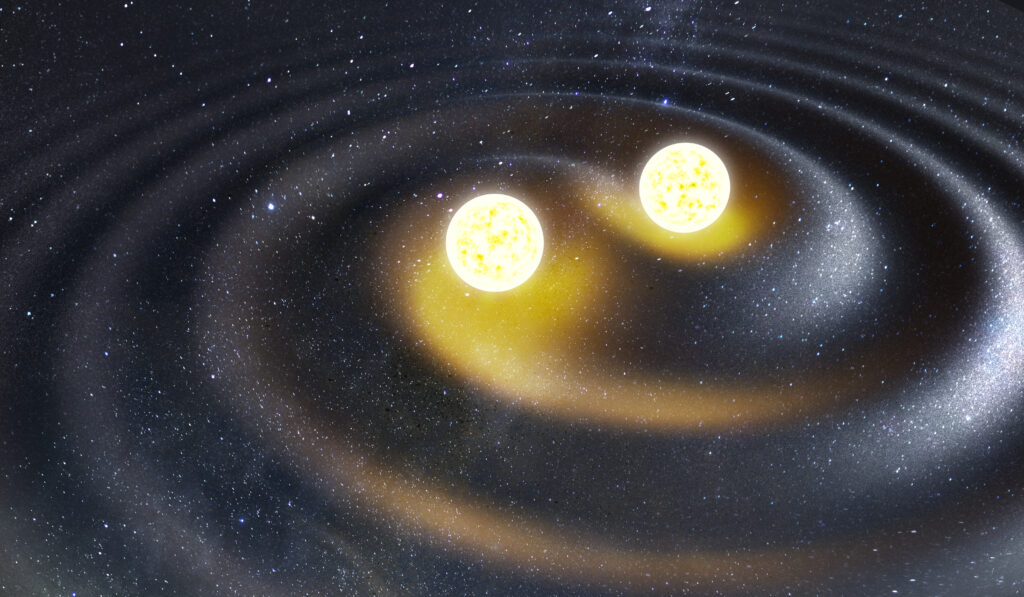
The Einstein Telescope (ET) is a next-generation European research infrastructure designed to detect gravitational waves with unprecedented sensitivity. By enabling groundbreaking discoveries on black holes, neutron stars and the origins of the universe, the ET will open a new chapter in our understanding of fundamental physics.
This event will bring together European stakeholders from academia, industry and government to explore the scientific, technological and economic opportunities of the Einstein Telescope. Participants will explore how Swedish expertise, research excellence and innovation ecosystems can contribute to the development of the Einstein Telescope, while identifying opportunities for scientific collaboration, industrial participation and technology partnerships with European stakeholders.
The event is organised by the Royal Swedish Academy of Sciences, in collaboration with KTH Royal Institute of Technology, the Embassy of Belgium, the Embassy of the Netherlands, the Embassy of Germany, the Delegation of Flanders in the Nordic Countries, Flanders Investment & Trade, AWEX and Wallonia-Brussels International. The event is free of charge and open to the public, but registration is required.
Reception Thursday 5 November
The Embassy of the Netherlands invites those who register to the symposium to a reception at the Embassy at 18.00 on 5 November. Registration is required, please find the link below. Note that due to limited capacity, your registration is subject to confirmation. You will receive a separate confirmation email from the Embassy once your place is secured.
Register for the reception here>
Morning session — scientific perspectives
08:30 Arrival and welcome
08:45 Observational astronomy with a third generation observatory
Samaya Nissanke, Lead Scientist at DESY, Head of Multi-Messenger Astrophysics at the DZA, Prof of Multi-Messenger Astrophysics at University of Potsdam
09:20 The Einstein Telescope: exploring the gravitational universe
Stefan Hild, co-Head of the Instrument Science Board of the Einstein Telescope collaboration, Head of the ETPath finder facility. Lecture on ZOOM
09:55 Coffee and move to the parallel breakout rooms
10:30 Thematic breakout sessions (three parallel tracks)
Each track opens with a 15-minute framing talk on the theme from the Einstein Telescope perspective, followed by 45 minutes of open discussion
-
Breakout A: Instrumentation for future detectors. Led by Anna Green, Assistant professor, Maastricht University, the Netherlands
-
Breakout B: Multi-messenger astronomy for future detectors. Led by Archisman Ghosh, Associate professor, Ghent University, Belgium
-
Breakout C: Observational cosmology and waveform modelling for future detectors. Led by Tanja Hinderer, Associate professor, Utrecht University, the Netherlands
11:30 Plenary panel — Swedish science for the Einstein Telescope
Presentation on what research is being done in Sweden in this field, followed by a panel focusing on the questions ”Formats for collaboration” and ”Opportunities for Swedish participation”.
12:15 Lunch
Valorisation — Industry and business opportunities
13:00 Why should industry be interested in the Einstein Telescope?
Stan Bentvelsen, Nikhef (Dutch National Institute for Subatomic Physics)
13:20 Valorisation of the Einstein Telescope: business opportunities and industrial participation
Maxime Corvilain, Valorisation Manager, Einstein Telescope EMR Project
Mike Olsson, Business Developer & Project Manager, Industrial Liaison Officer (ILO): ESS, ILL and ESRF, Big Science Sweden
14:10 Short coffee break
Afternoon session — Building ET: collaboration, technology and Swedish science
14:30 ET as a collaboration
Angélique Lartaux, Deputy head of Einstein Telescope collaboration
14:55 ETO and the philosophy of site selection
Andreas Freise, Einstein Telescope Organisation and professor at VU, Amsterdam, the Netherlands
15:25 Gravitational waves from supernova explosions
Evan O’Connor, Associate Professor, Stockholm University, Sweden
15:55 Newtonian noise cancellation
Stefan Danilishin, Associate professor, Maastricht University, the Netherlands
16:20 Wrap-up, takeaways and close — What is Sweden’s interest in ET and which communities should become more involved?
16:30 End of event
The Royal Swedish Academy of Sciences occasionally records and photographs during its events. Photographs and video footage will be processed by the Academy and submitted to third parties for processing. Photographs and videos may also be used in our communication activities to provide information about the Academy’s activities in any of the digital and/or printed channels used by the Academy. If you do not consent to this or have other questions about our processing of personal data, please call us on +46 8 673 95 00, or email: gdpr@kva.se
Read more about how the Academy processes your personal data
Kontakt: Peter Brandén
E-post: program@kva.se