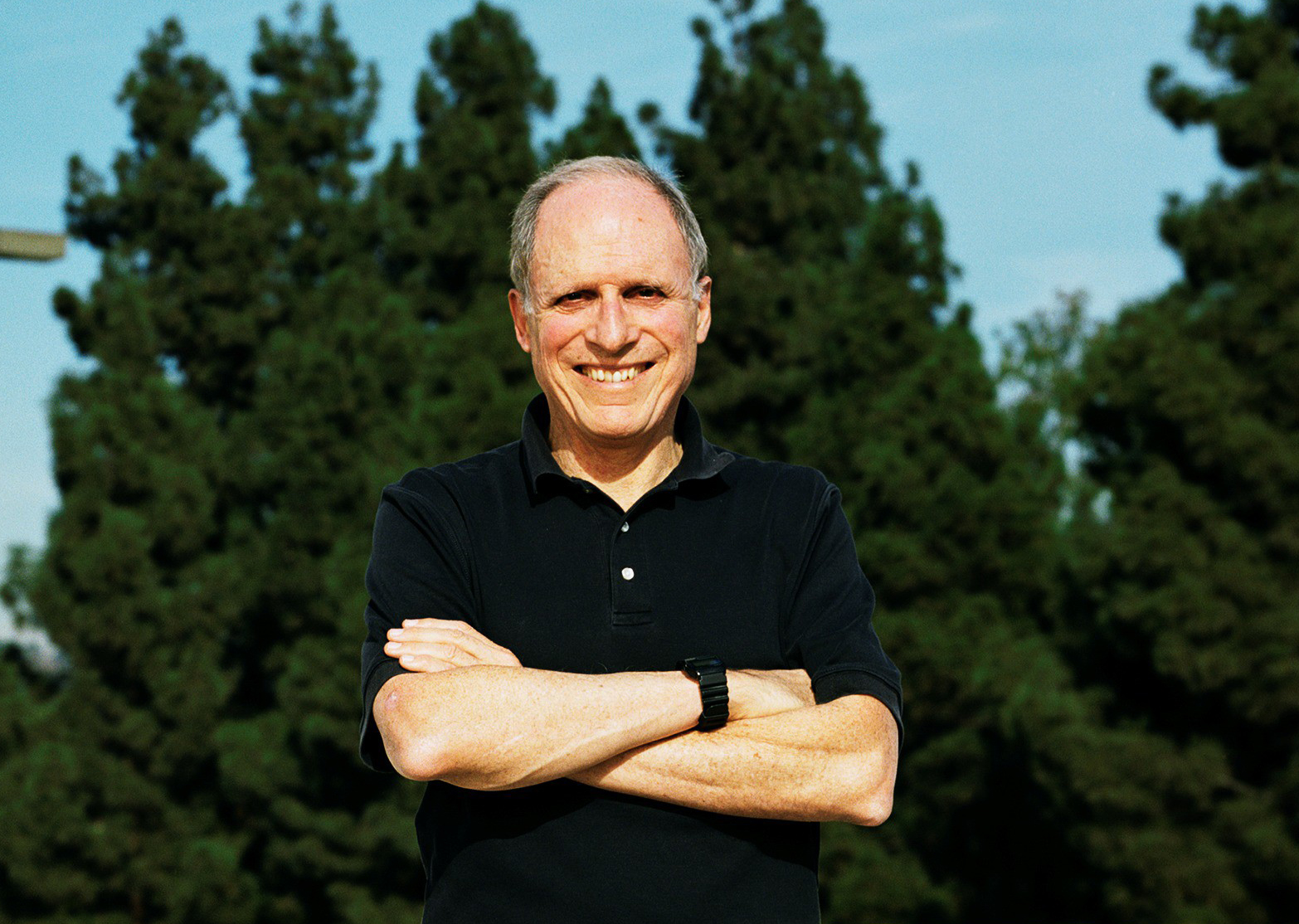
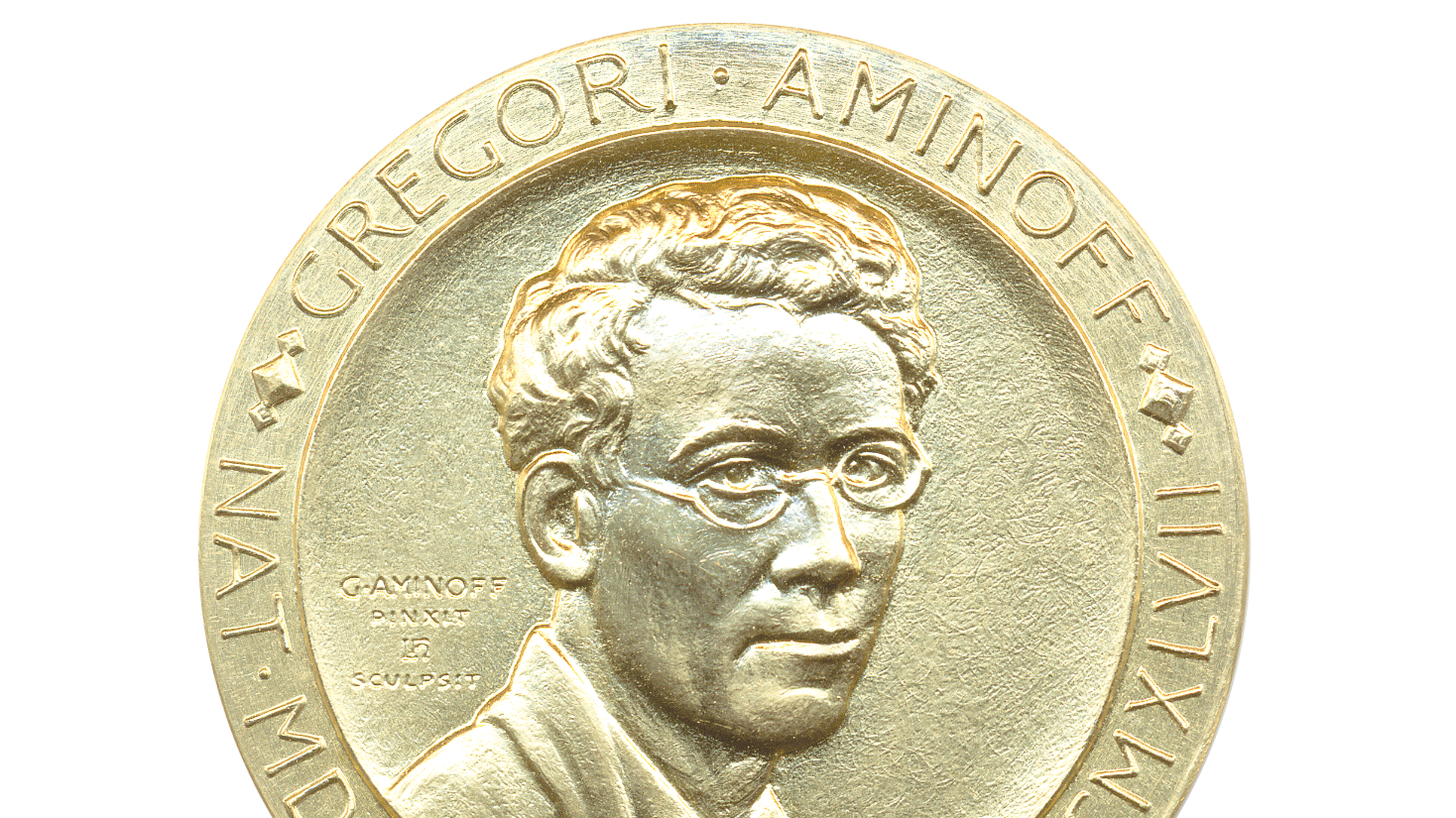
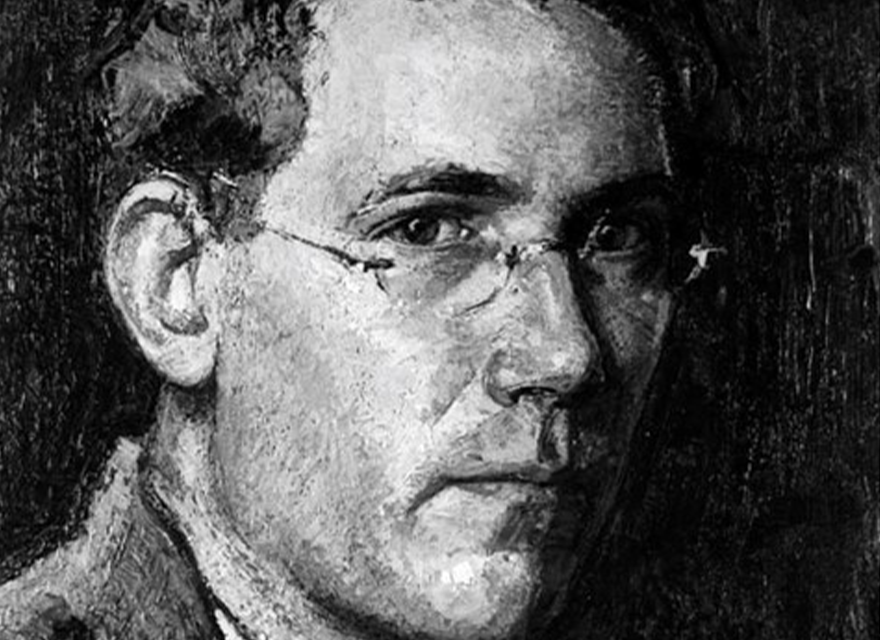
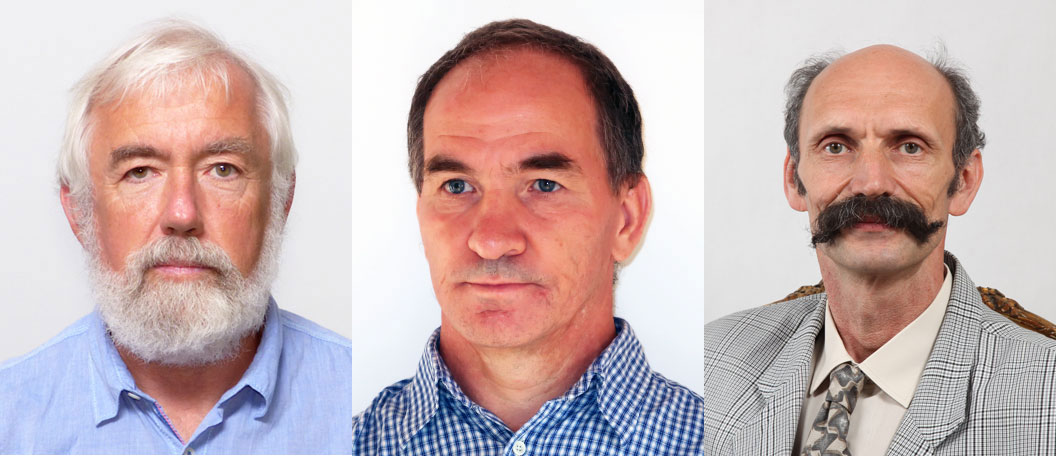
Miklós Tegze, Gábor Bortel and Gyula Faigel have developed a new way of determining how atoms are organised in a material, by using Kossel crystallography. With the help of a pulse from a free-electron laser they were able to determine a three-dimensional structure extremely quickly. For this achievement, The Royal Swedish Academy of Sciences is awarding them the Gregori Aminoff Prize in crystallography.
Researchers can establish the structure of a material by determining how the atoms are arranged in relation to one another. Previously, this required numerous different measurements taken from different angles, but the development of free-electron lasers has brought new opportunities for discovering how matter is structured.
Very short pulses
A free-electron laser can produce very short and very intense pulses of electromagnetic radiation. This year’s laureates used just one of these pulses, which lasted only around 25 femtoseconds – 25 millionths of a billionth of a second – to determine a crystal’s three-dimensional structure.
This is a new method for investigating matter and can also be used to study rapid structural changes in materials. For example, researchers may be able to improve their understanding of what happens when a substance changes from one state to another.
for their development of “Kossel crystallography” allowing extremely fast 3D structural determination using free electron lasers.
FACTS The laureates
Miklós Tegze earned his Ph.D. from the Central Research Institute for Physics, Hungary, in 1981. In 2001, he became a doctor of the Hungarian Academy of Sciences. He started work at the Central Research Institute for Physics in 1982. Since then he has also been a visiting scientist at the University of Groningen, the Technical University of Vienna and CEA Grenoble. He retired at the end of 2022 and is now a Professor Emeritus.
Gábor Bortel earned his C.Sc. (Ph.D. equivalent) in Physics from the Hungarian Academy of Sciences in 1997. He worked as a visiting scientist at the Advanced Photon Source at the Argonne National Laboratory, USA, between 1997 and 1999 and then as a research fellow at the Research Institute for Solid State Physics and Optics of the Hungarian Academy of Sciences. Since 2003 he is a senior research fellow at the institute that is now part of the HUN-REN Wigner Research Centre for Physics.
Gyula Faigel earned his Ph.D. from the Hungarian Academy of Sciences in 1988. He became a doctor of the Academy in 1998, and a research professor and leader of the X-ray laboratory at the Research Institute for Solid State Physics and Optics the year after. He became a member of the Hungarian Academy of Sciences in 2001 and retired in 2024.
The Gregory Aminoff Prize
Every year, the Gregori Aminoff Prize in crystallography is awarded by the Royal Swedish Academy of Sciences. The Prize recognises a documented individual contribution to the field of crystallography and has been awarded to Swedish and foreign researchers since 1979. The prize amount is 180,000 Swedish kronor to be shared equally between the laureates. Crystallography is the study of atomic structures in solid materials and is used in chemistry, biology, medicine, geology and materials science.
Contact
Expert:
Björgvin Hjörvarsson, Professor in Physics at Uppsala University and member of the Prize Committee
bjorgvin.hjorvarsson@physics.uu.se
Press Contact:
Eva Nevelius, Press Secretary at The Royal Swedish Academy of Sciences
eva.nevelius@kva.se
070-878 67 63