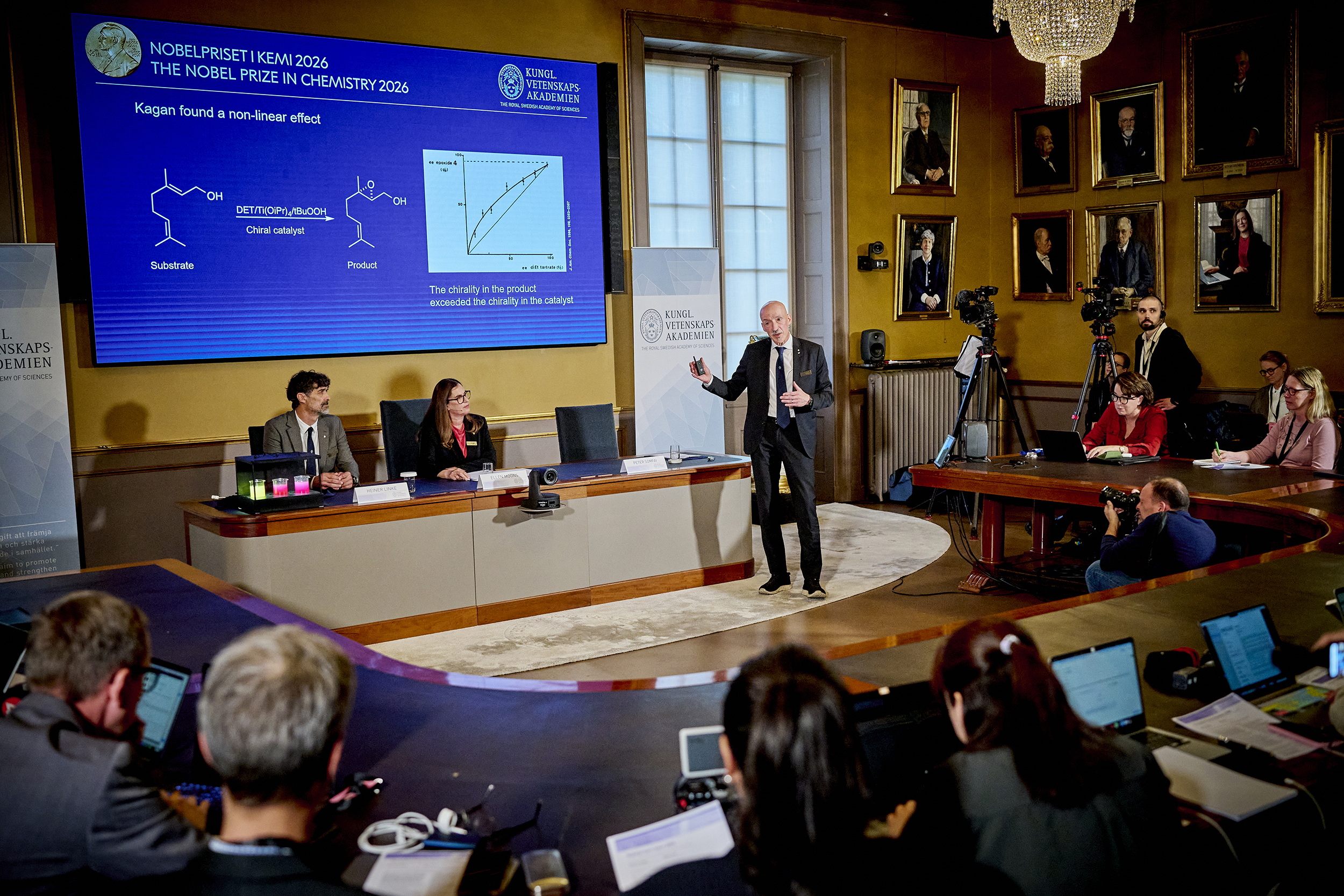
Some chemical reactions create two different molecules, each the mirror image of the other. For decades, researchers knew that it was theoretically possible to design reactions in which only one of these mirror images would be formed, but how to do this in practice remained a mystery. Henri B. Kagan and Kenso Soai are awarded the Nobel Prize in Chemistry 2026 because they provided a solution. Their discoveries are hugely important for chemists who design reactions that are utilised in applications such as pharmaceutical manufacturing.
Popular Science Background to the Nobel Prize in Chemistry 2026
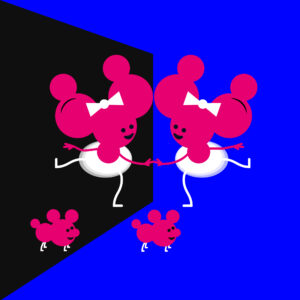
The molecules of life make things difficult for chemists. Imagine that you are a locksmith who makes keys to order. The problem is that when you produce them, you always end up with two mirrored variants, but only one of them fits the lock – and the lock can be damaged if your customers try to unlock it with the other key. Unfortunately, telling the keys apart is very difficult, so the customer gets them both.
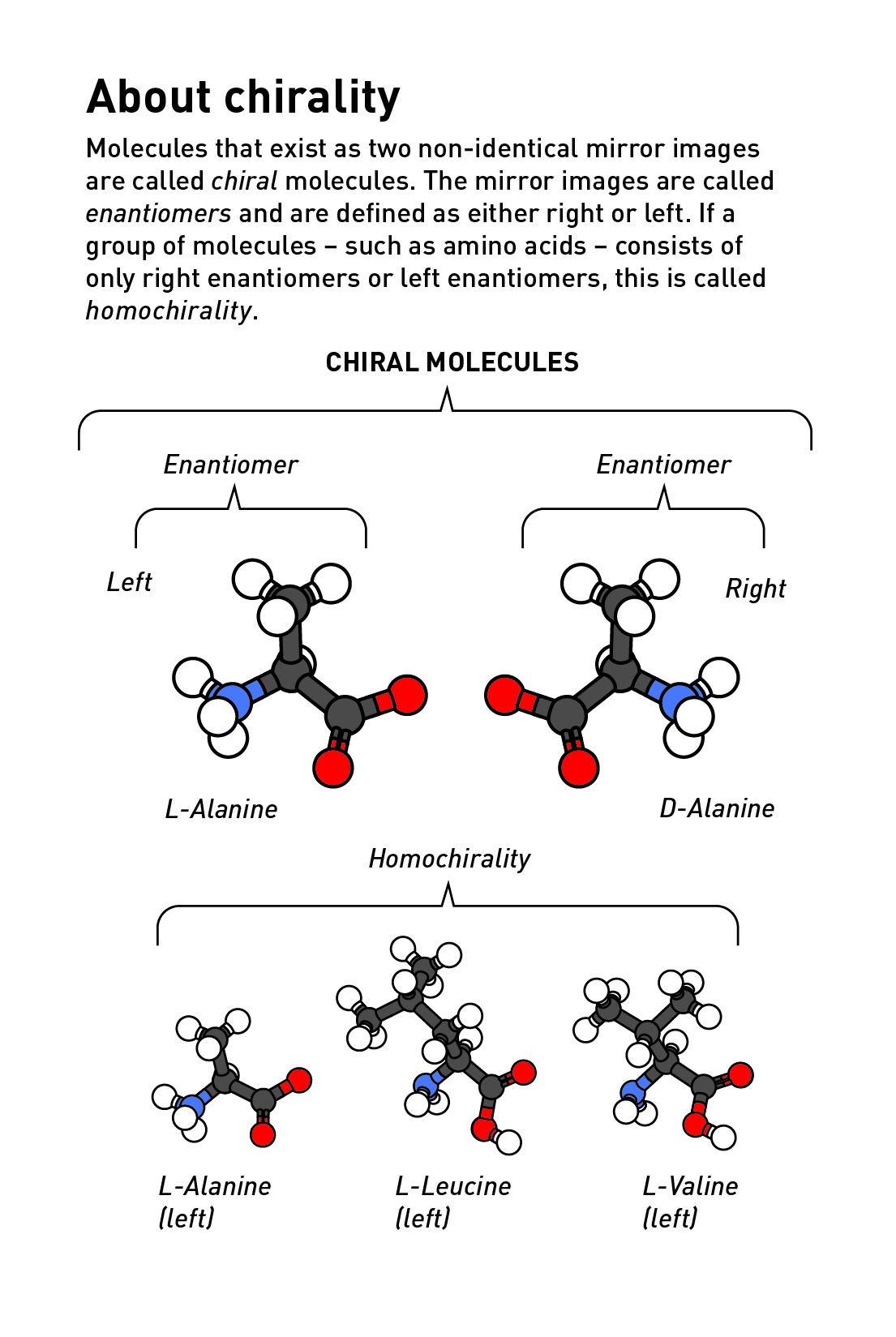
There are similar challenges when chemists develop new pharmaceuticals. Many of the drug molecules occur in two variants that are each other’s non-identical mirror image: one has the therapeutic effect, while the other can cause unnecessary and sometimes harmful side effects. The underlying reason for this is linked to the fundamental chemistry of life: life is what chemists call homochiral, from the Greek words for “same” and “hand”. Like hands, all amino acids exist as two mirrored variants, but only one of them is found in the proteins in your cells. The other is rarely found in nature. This is also true of the sugar molecules that are part of our DNA; there are two different mirror images of these molecules, but life only uses one.
Chemists have long wondered how homochirality can emerge. Henri Kagan and Kenso Soai are awarded the Nobel Prize in Chemistry 2026 because they found a solution to this puzzle. Henri Kagan discovered a new way of manipulating chemical reactions, allowing a greater excess of one of the mirror images to be created than was previously assumed possible. His discovery has been revolutionary for chemists who develop reactions for the manufacture of pharmaceuticals, flavours, scents and new materials.
Kenso Soai designed the first chemical reaction in which only one of the potential mirror images was formed. Other than life itself, no one had ever achieved this feat. The Soai reaction is one of the most spectacular chemical experiments ever conducted.
The Nobel Prize in Chemistry 2026 results from a long chain of ideas, of which the first link was forged in the mid-19th century. It all began with Louis Pasteur investigating a substance that is important for wine production: tartaric acid.
Tartaric acid reveals that molecules can be mirrored
Pasteur looked at most of what he wanted to study through his microscope. When his colleagues claimed that tartaric acid sometimes bent polarised light to the right, but at other times did not affect the light at all, his interest was piqued. He grew crystals of tartaric acid and examined them under his microscope – and he discovered that they existed in two variants, each the other’s mirror image. Using tweezers, he divided them up and dissolved them separately. When he sent polarised light through the liquids, one bent the light to the right and the other to the left. If he combined the liquids, the light was unaffected.
This experiment provided chemists with the insight that some substances occur in two mirrored variants. Eventually, these substances came to be called chiral, and the two molecules that are each other’s mirror images enantiomers (figure 2).
Life’s one-handedness puzzles researchers
Pasteur made the next important observation in 1857, when he investigated what happened when bacteria fermented tartaric acid’s different enantiomers. It turned out that the bacteria willingly fermented the enantiomer that is found in grapes and which bends light to the right. However, the bacteria were uninterested in the mirror-image molecule. It remained untouched. Thus the idea that life’s chemistry is somehow chiral first saw the light of day. Later, when researchers began studying life’s building blocks, they discovered that naturally occurring amino acids are always left-handed, while the sugars found in the DNA helix are right-handed.
The insight that life’s molecules only contain one of two possible enantiomers led to the next question: what happened at the dawn of life that made life’s chemistry one-handed? When chemists experimented with reactions that formed chiral molecules, they always obtained an even mix of both enantiomers in their test tubes. So why do living organisms only use one mirror image of amino acids? How can homochirality even arise?
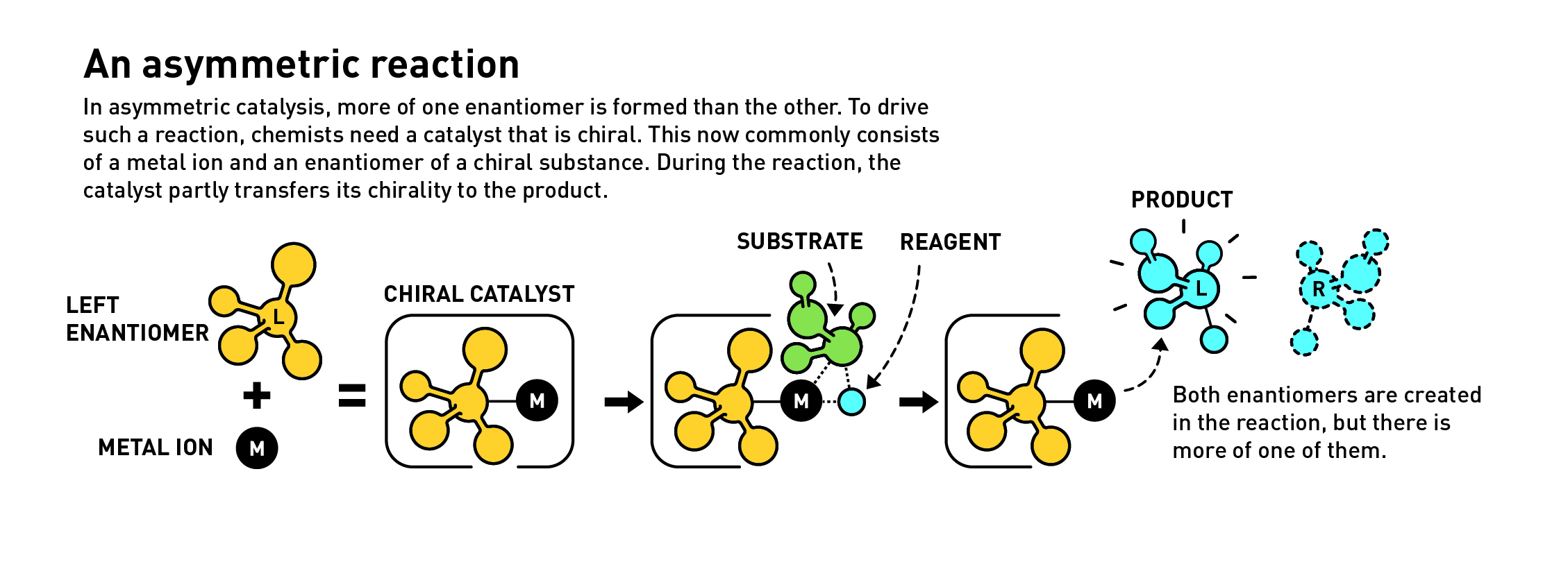
Some chemists claimed that chiral chemistry was unique to life. However, in the early 1900s, a German chemist, Willy Marckwald, carried out the first successful reaction that was asymmetric (figure 3). This means that more of one enantiomer was created than the other. The key was that Marckwald used a catalyst – a substance that drives chemical reactions without being consumed. In this reaction, the catalyst was chiral, so it boosted the formation of one mirror image rather than the other. The difference was very small, but its mere existence was a breakthrough.
The next important link in the idea chain for the Nobel Prize in Chemistry 2026 was forged in 1953. It consisted of purely theoretical reasoning that was presented in a scientific article.
Life’s lopsided chirality gets a mathematical explanation
Some surprise shines through in the article’s introduction. Its author – Charles Frank, from the University of Bristol – was a theoretical physicist, who describes how a colleague informed him that chemists still do not understand how life’s asymmetry arose. According to this colleague, a mathematical solution to the problem would be helpful to chemists. In response, Frank presents a model for a chemical reaction in which three conditions must be fulfilled:
- That there are a chiral catalyst and an asymmetric reaction.
- That the formation of one mirror image is somehow enhanced and the other dampened.
- That the chemical reaction forms the catalyst itself. This is called autocatalysis and causes a self-reinforcing effect, resulting in the number of one of the enantiomers in a reaction growing exponentially.
A chemical reaction that fulfils all these conditions can result in homochirality. Frank’s model spread widely among chemists, becoming a kind of chemical puzzle that university lecturers could present to their students – how could these conditions be translated into chemical reality?
As described above, Marckwald succeeded in fulfilling the first condition at the start of the twentieth century, but only later did researchers manage to design chemical reactions that were meaningfully asymmetric. Pioneers in this field were awarded the Nobel Prize in Chemistry in 2001 and 2021.
The Nobel Prize for Chemistry 2026 recognises the fulfilment of the two remaining conditions. We begin with the simple and ingenious idea that led to Henri Kagan, in 1986, putting a tick beside the second condition in Frank’s model.
Kagan thinks outside the box
Kagan, who worked at Université Paris-Sud, was one of all the chemists working to refine asymmetric reactions in the early 1980s. The aim was to produce enantiomers that were as pure as possible, for example in pharmaceutical manufacturing. The importance of achieving this had been shown by the thalidomide scandal in the early 1960s, when thousands of children were affected by birth defects caused by a sedative, thalidomide. When researchers analysed what had happened, they realised that it was the active substance’s mirror image that caused the harm.
To drive asymmetric reactions, researchers often used catalysts with two components: a metal atom that functioned as the motor in the reaction and a chiral substance that ensured the reaction was asymmetric.
Because researchers aimed to obtain pure enantiomers in the product, they normally used an enantiomer that was as pure as possible in the catalyst. However, they assumed that if they combined two mirrored enantiomers in the catalyst, the product would have the equivalent proportions. In other words, they believed that the catalyst’s chirality was transferred to the product’s chirality and that there was a linear relationship between the two.
Kagan began to question this assumption. As a skilled chemist, he took the time to think about the catalyst itself in more detail. No one actually knew how it worked – during the chemical reaction the metal atom and the chiral molecule obviously interacted, but the question was how this happened.
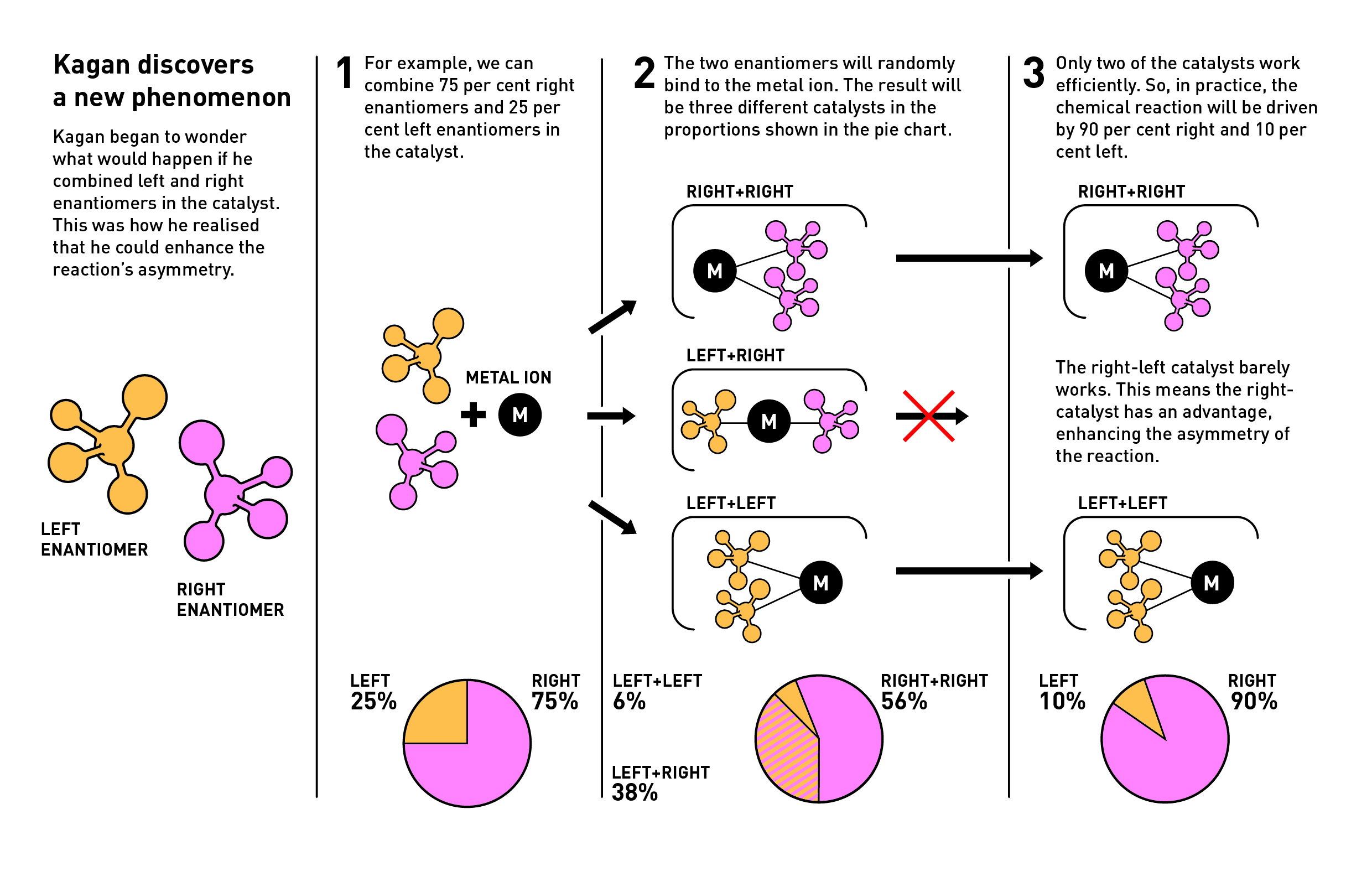
Metal atoms normally interact with several molecules simultaneously. Kagan therefore assumed that the catalyst’s metal attracted at least two of the chiral molecules during the chemical reaction. If the right and left enantiomers were then combined, there would be three forms of the catalyst, which you can see in figure 4: right-right, left-right and left-left.
The catalysts that were right-right and left-left would create products that were mirror images of each other – but how would the left-right catalyst react?
Kagan succeeds in enhancing asymmetry
This reasoning led Kagan to a joker in the pack, as the left-right catalyst behaved differently to the other two. When he tested driving a reaction with different combinations of enantiomers in the catalyst, the relationship to the proportions in the product was not linear, as other chemists had assumed. Instead, the graph that Kagan obtained when he plotted his results was curved (figure 5). The reason was that the left-right catalyst drove the chemical reaction far more slowly than the catalysts that were right-right or left-left (figure 4).
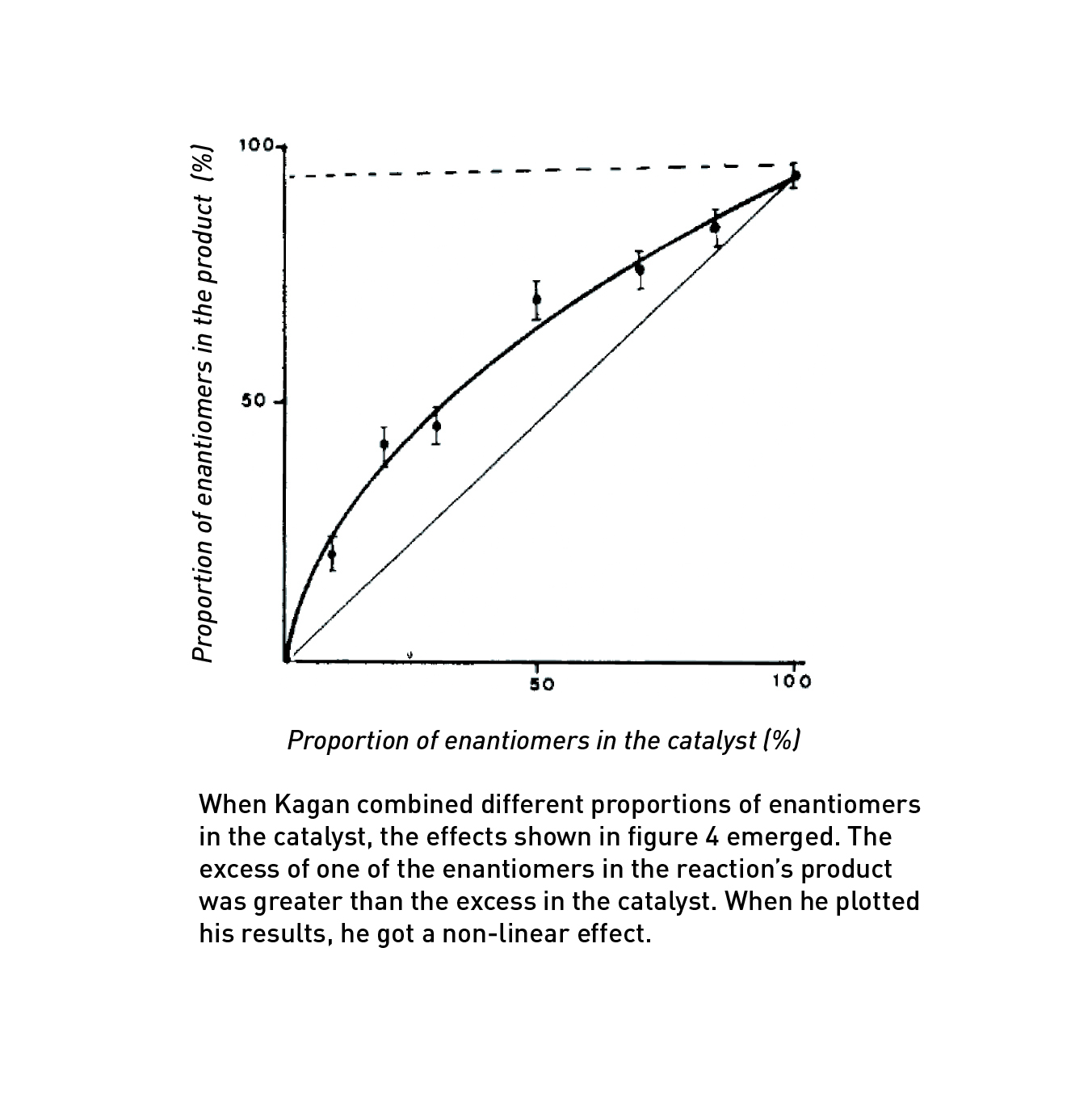
In practice, this meant that he had found a method for enhancing the formation of one of the enantiomers in the product (figure 4). He had thus fulfilled the second condition in Frank’s model. In 1986, he described no fewer than three different asymmetric reactions that displayed what chemists call non-linear effects. This was a historic breakthrough, and many chemists began to explore this new phenomenon. One of them was Kenso Soai at the Tokyo University of Science, who came to forge the final link in the idea chain for the Nobel Prize in Chemistry 2026.
Trial-and-error brings results for Soai
Kenso Soai explored an asymmetric chemical reaction that had a major non-linear effect. When he scrutinised the structures of the reaction’s catalyst and the product that was formed, he realised they had significant similarities. This sparked an idea – perhaps he could design a reaction in which the catalyst formed itself in an autocatalytic process?
At this time – in the early 1990s – there were several known examples of autocatalytic reactions, but none were asymmetric. By experimenting with many different molecules, Soai succeeded in finding a chiral substance – 5-pyrimidyl alkanol – which could create itself. In a publication from 1995, he describes this revolutionary experiment. He started with a two per cent excess of one enantiomer of 5-pyrimidyl alkanol and ended with an excess of 87 per cent. The reaction was self-reinforcing and fulfilled all Frank’s criteria, but it did not achieve the 100 per cent enantiomeric purity of life.
Soai’s elegant reaction solves the puzzle
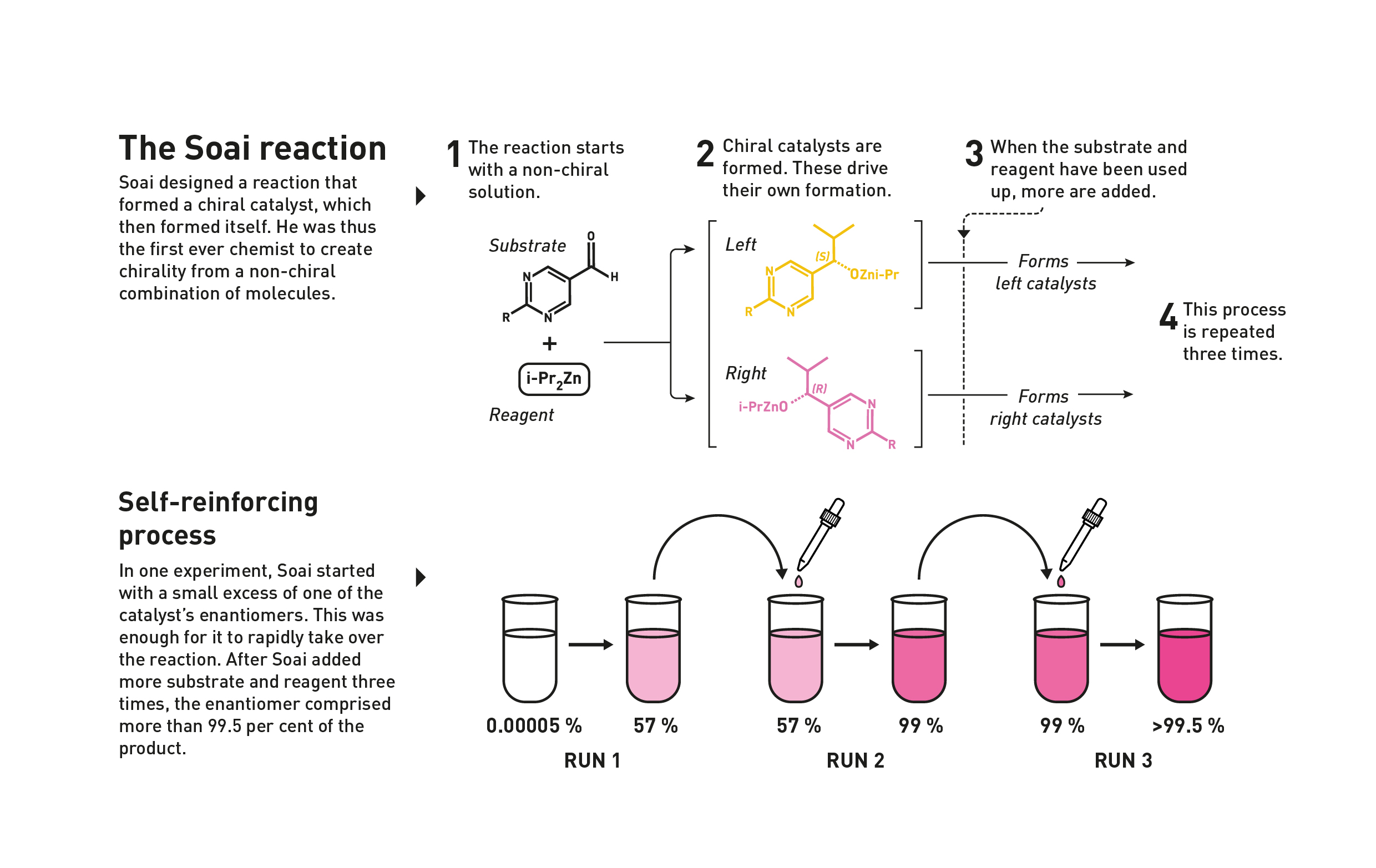
For another eight years, Soai continued his search for the ultimate autocatalytic process. In 2003, he was finally able to present a chemical reaction that formed an excess of an enantiomer, which then formed copies of itself (figure 6). This was the first time anyone had successfully created chirality from a non-chiral combination of molecules since the dawn of life.
The Soai reaction is considered one of the most elegant chemical experiments ever conducted. When Soai started the catalytic process, both enantiomers were created but, because chance governed the process, slightly more of one of them was formed. This tiny excess was enough for the enantiomer to take over the entire chemical reaction. Ultimately, it can comprise 99.99 per cent of the product. When Soai repeated the reaction, the other enantiomer could take over instead; the enantiomer he obtained at the end depended on what happened by chance at the start of the reaction (figure 6).
Chemists have gained sharp new tools
The Soai reaction is artificial, different to the chemistry of life, but it awakened new enthusiasm in chemists who want to understand the life’s origins. Around the world, researchers are now trying to repeat Soai’s achievement, but with the aim of producing homochiral amino acids and sugars.
The non-linear effects that Kagan discovered have become an important tool for chemists when they design new reactions. The fact that a reaction is non-linear provides chemists with information about how it occurs. This information can be used to optimise the reaction, so they can obtain the purest possible enantiomers of the product. This is vital for every company that manufactures substances that are intended to interact with living beings, such as pharmaceuticals, flavours, scents and agricultural chemicals. In some cases, it is also important in the production of new materials.
Thanks to the discoveries that are now being awarded with the Nobel Prize in Chemistry 2026, chemists have gained fundamental new tools for use in their daily work but, above all, these discoveries have contributed to solving one of chemistry’s greatest mysteries: how homochirality – like that found in all living beings – can be created.
The Nobel Prize in Chemistry 2026
Laureates
Henri B. Kagan, born 1930 in Boulogne-Billancourt, France. PhD 1960 from Collège de France, France. Professor Emeritus at the then Université Paris-Sud, France.
Kenso Soai, born 1950 in Hiroshima, Japan. PhD 1979 from University of Tokyo, Japan. Professor Emeritus at Tokyo University of Science, Japan.
Citation
“for the discovery of non-linear effects and autocatalysis in asymmetric organic synthesis”