Andris Vaivads and Piero Baglioni have been elected as new members of the class for astronomy and space science and the class for engineering sciences, respectively. Andris Vaivads studies what is commonly known as the magnetosphere around the Earth, other planets and the Sun. Piero Baglioni has used his knowledge of colloids and nanoparticles to find new methods for the cleaning and conservation of artworks.
Class for astronomy and space science
Foreign member
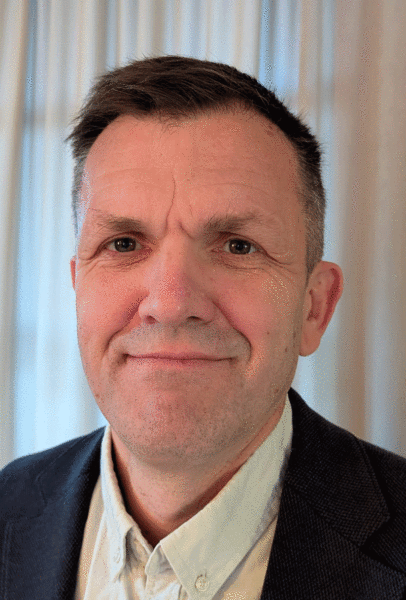
Andris Vaivads is the Rector of Ventspils University of Applied Sciences in Latvia and Professor in Experimental Space Physics at KTH Royal Institute of Technology in Stockholm. Earlier, he was a researcher at the Swedish Institute of Space Physics in Uppsala for 20 years. He studies what is known as the magnetosphere around the Earth, other planets and the Sun. Much of space is filled with plasma, a gas consisting of electrically charged particles that are influenced, among other things, by magnetic fields. When magnetic fields pointing in different directions reconnect – a process known as magnetic reconnection – large amounts of magnetic energy can rapidly be converted into other forms of energy, including kinetic energy.
Andris Vaivads’s research focuses on these processes, in which large amounts of energy are converted within small regions in space. Plasma processes can, among other things, give rise to Northern lights (Auroras), affect satellites and heat plasma to tens and hundreds of millions of degrees.
The research group at KTH, in which Andris Vaivads participates for 20 percent of his working time, develops instruments for measuring electric fields on satellites. The group also designs small measurement probes that can be launched on rockets from Esrange Space Center in Kiruna. More recently, Andris Vaivads has also studied processes in the solar wind, a kind of plasma wind that plays a major role in space weather. This research has used observations made by spacecraft launched by both ESA (Solar Orbiter) in Europe and NASA (Parker Solar Probe) in the US.
Andris Vaivads, Ventspils University of Applied Sciences
Class for engineering sciences
Foreign member
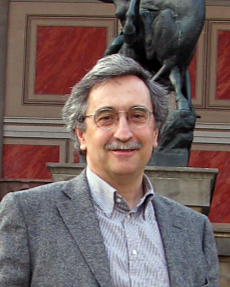
Piero Baglioni is a professor of physical chemistry at the Università di Firenze, Florence, Italy, whose research focuses on colloid and surface chemistry. This is a field within physical chemistry that studies nanoparticles, complex fluids, and chemical gels from nano- to micro-scale.
In his research on various types of colloids and nanoparticles, Professor Baglioni has also developed new methods for the cleaning and conservation of artworks. These methods have, among other things, been used to restore many iconic artworks including Pollock, Lickteinstein, Modigliani and Picasso paintings. The Picasso painting “L’Atelier” (The Studio) had been covered in wax and clear varnish, which dulled its original colours. Using Baglioni’s method, it was possible to dissolve the unwanted layer without the dissolving solution spreading and damaging the painting, allowing L’Atelier to regain its original colour and luster.
Professor Baglioni’s methods have also been used to restore and preserve Swedish cultural heritage. When it was discovered in 2000 that the Vasa ship was deteriorating from the inside due to sulfuric acid forming in the wood, Professor Baglioni and his research group were called in. Baglioni utilized a method that neutralized the acid and thereby halted the degradation, without altering the ship’s appearance or stability. Baglioni’s methods have also been applied in Vendel Church in Uppland, in this case to restore 15th-century frescoes (paintings created on damp lime plaster) on the church walls.
Professor Piero Baglioni is internationally recognized as an expert in the restoration and conservation of cultural heritage.