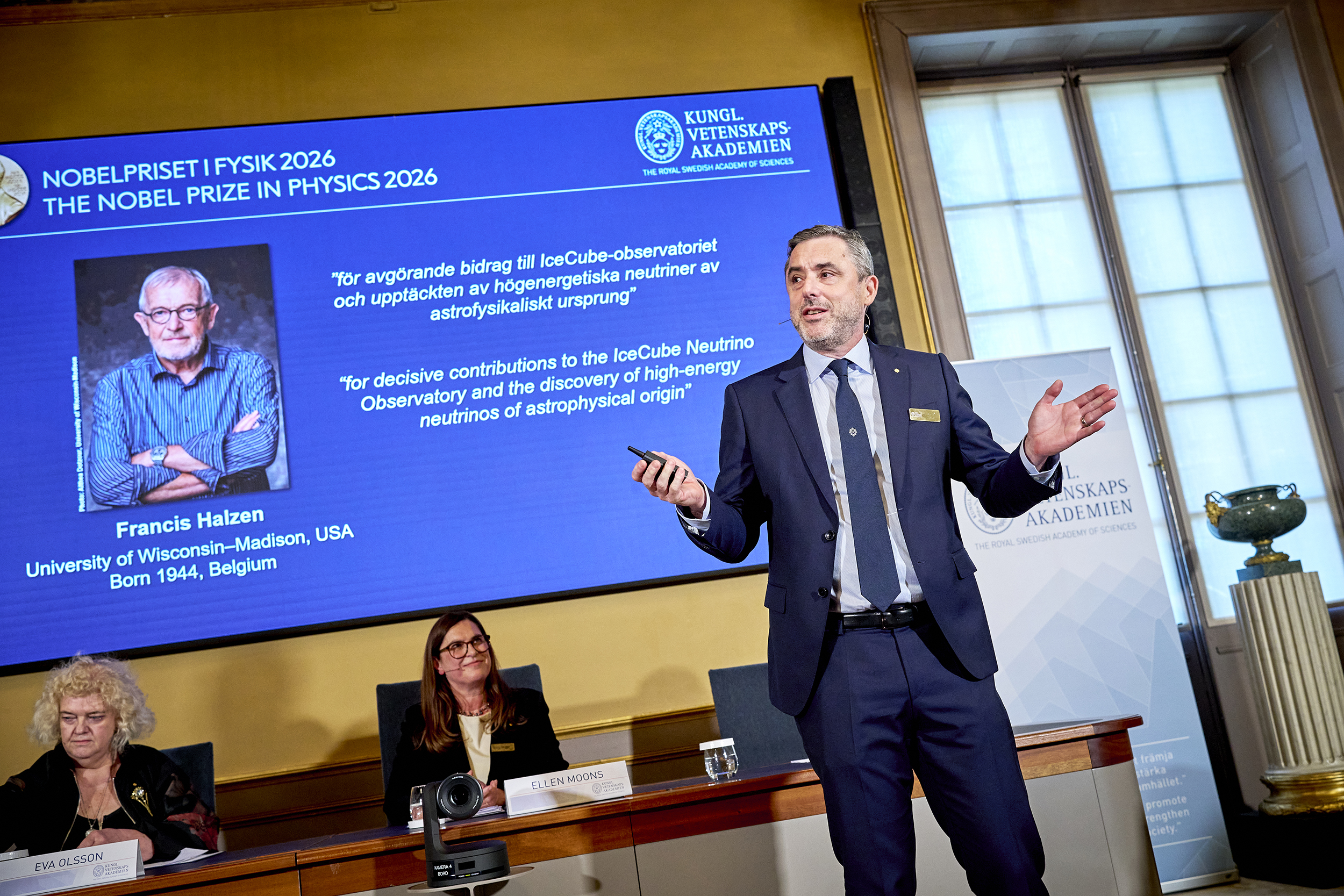
Francis Halzen has laid the foundation for an entirely new type of astronomy. His idea was to use glacial ice at the South Pole to capture the secretive particles called neutrinos. The result was the IceCube Neutrino Observatory, which can track neutrinos that originate in the distant cosmos.
Popular Science Background to the Nobel Prize in Physics 2026
The neutrino is the shyest particle in the universe, has no electric charge and almost no mass. In general, it passes unnoticed through matter – seldom does a neutrino make its presence felt by colliding with an atomic nucleus. Every second, without you noticing, 65 billion neutrinos from the Sun flow through your little finger nail.
Neutrinos also come from other regions of space, carrying clues to some of the mysteries of the cosmos. Researchers that succeed in capturing these rarer cosmic neutrinos can then extract information about the extreme environments in the universe where they originated.
Back in the 1980s, Francis Halzen had realised that the Antarctic ice could be ideal for ensnaring enough of these secretive neutrinos, so researchers could learn more about their distant origins. He quickly convinced many others of his idea’s potential and, in 1992, a group of tenacious researchers and engineers made the first attempts to lower light sensors into the glacier at the South Pole. The breakthrough came around twenty years later: the IceCube neutrino telescope registered neutrinos with properties that convinced researchers they originated in distant regions of space. The hunt for the universe’s neutrino sources had begun in earnest.
Particle physics meets astrophysics
Halzen grew up in Belgium. He was attracted to particle physics by the progress in the field in the 1960s and, initially, he focused on massive particles that are built from quarks. Soon after finishing his PhD he moved to the University of Wisconsin–Madison in the US. Later, he came to understand what particle physics can learn from particles that reach us from space – and how astrophysics can, in turn, benefit from particle physics.
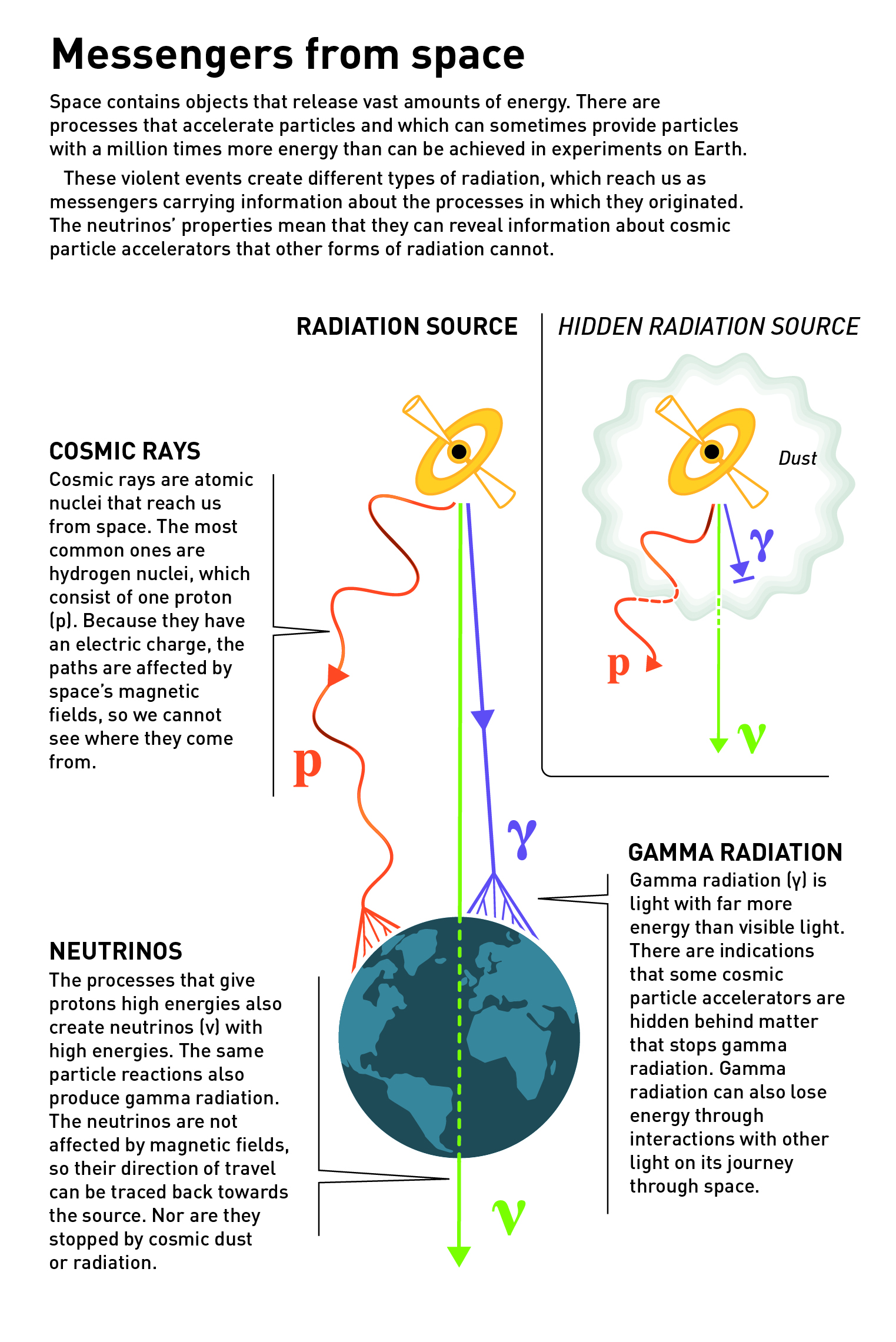
The motivation underlying the search for neutrinos comes from observations of completely different particles. The cosmos is continuously traversed by particles that are collectively called cosmic rays. Typically, these particles are protons, which are naked atomic nuclei of hydrogen. Protons from space can sometimes reach us with an astounding amount of energy, far more than it is possible to give them in a particle accelerator on Earth.
The origin of cosmic rays with the most extreme energies has been one of the universe’s best-kept secrets. Because physics tells us that the processes that can accelerate protons to high energies also give rise to neutrinos with high energies, neutrinos could provide crucial clues about these cosmic particle accelerators.
Someone who succeeds in identifying neutrinos that carry huge amounts of energy can differentiate them from the considerably lower energy neutrinos that come from decaying radioactive substances, or from the Sun, or which arise when cosmic rays hit the Earth’s atmosphere. Neutrinos that do not originate in our surroundings must come from somewhere far, far away – perhaps from violent processes in regions where stars have exploded or from distant active galaxies.
Flashes in the ice
In the 1980s, while Halzen was working with cosmic particles, he heard that Soviet researchers were planning to use radio receivers to capture neutrino signals in Antarctica. The idea was that when a neutrino collides with an atomic nucleus in the ice it causes an electric spark, which produces a radio wave. If this was strong enough, it could be captured using a radio antenna. Halzen was inspired and realised that another method could be to install light sensors in glacier ice and look for flashes of light from the collisions.
Previously, around 1960, several physicists had suggested that water could be a good material for capturing neutrinos from space. On the rare occasions that a neutrino collides with an atomic nucleus, a charged particle is produced; this then travels in the same direction as the original neutrino and emits a blue light. Because water is transparent, this light can be detected. If the right equipment is used, it is possible to determine the direction of the light’s path and even see where the neutrino came from. The most important factor is having a volume of water that is large enough to see the evidence of many neutrino collisions.
Halzen’s idea was to use naturally occurring ice, rather than water. He contacted his research colleague John G. Learned, who was working on the DUMAND project. This was a similar project that aimed to capture light signals from interacting neutrinos in the deep and clear ocean water off Hawaii. Together, the physicists discussed the opportunities and challenges involved in capturing neutrinos in Antarctica. They first presented their concept for a neutrino observatory in the ice of the South Pole in 1988, at a conference in Poland.
A neutrino telescope at the South Pole
Francis Halzen realised that there were many advantages to siting the neutrino observatory at the geographic South Pole: a research station was already located there, with an organisation for regular transports and everything necessary for a team to work.
Ice also offers many benefits as a material. At a great enough depth, the darkness is constant. Unlike the ocean, there is no interference from living creatures, and there are only low levels of radioactive substances. The ice is stable and provides a solid surface for the people working at the facility. The area is geologically stable with no earthquakes.
One disadvantage is that the cold makes travel to and from the South Pole impossible for much of the year. All the practical work must be conducted during the brief Antarctic summer, between November and February.
At first, Halzen was satisfied with doing the theoretical work, while Learned was busy with his own project and never returned to their theories about capturing neutrinos at the South Pole. The story could have ended there – but the concept had generated so much interest that, within a few years, researchers from various institutions had gathered around Halzen to bring his idea of a neutrino observatory in Antarctica to fruition.
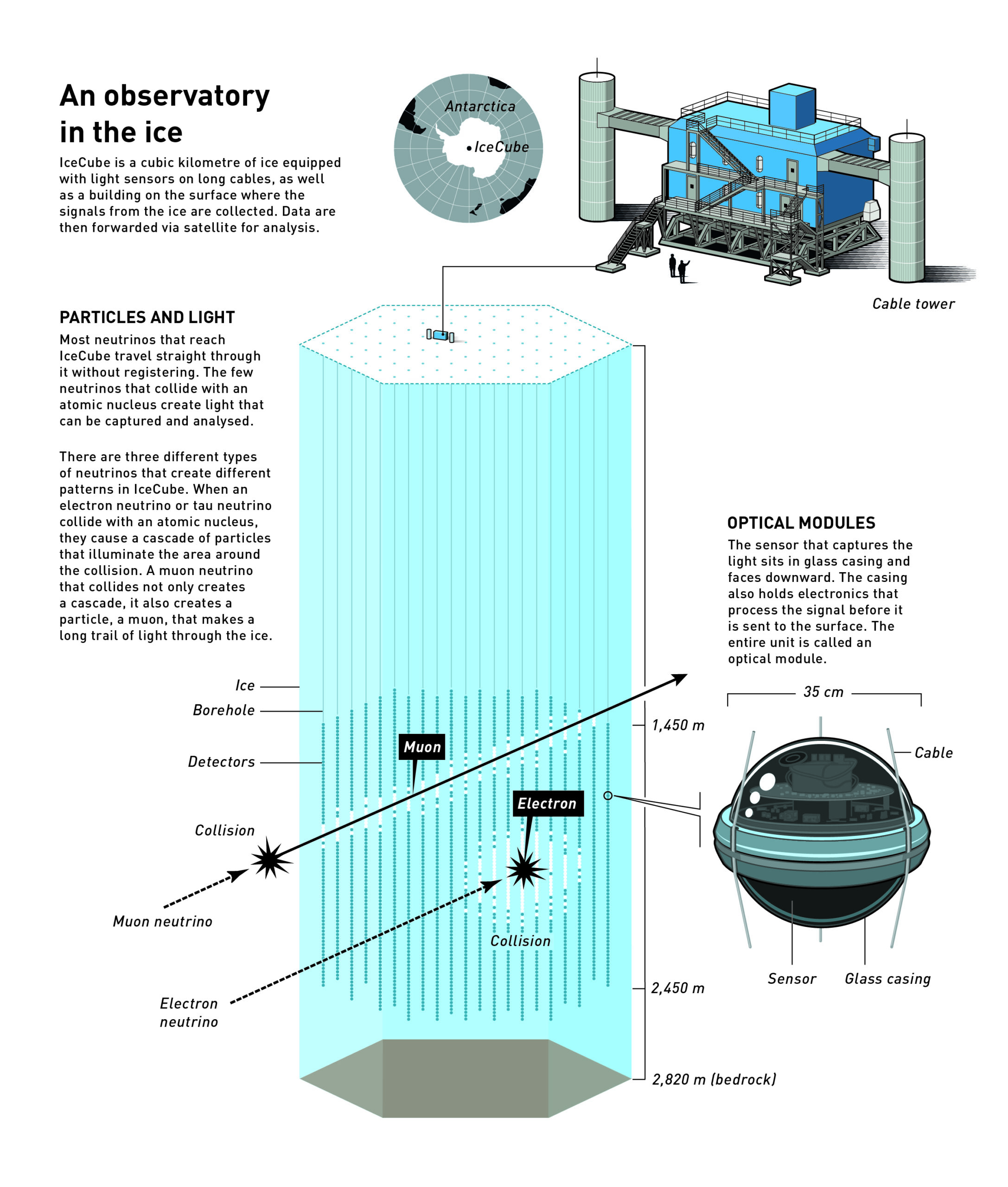
To start with, they had to solve all the practical problems entailed by placing instruments deep in the ice. From glaciologists, they learned that kilometre-deep holes can be drilled using a type of sophisticated shower head that uses hot water to melt the ice. A long cable with strings of light sensors could then be lowered into the waterfilled hole. Halzen describes these sensors as a lightbulb in reverse – the instrument captures light and then transforms it into an electrical signal.
Bubbles in the ice could cause problems
First, the research team tested sinking the sensors into the ice on Greenland to check that they could register light from the particles in the ice. Then they began constructing the first neutrino observatory at the South Pole, IceCube’s predecessor: AMANDA.
Halzen has described sitting at the dinner table with his computer in his lap on Christmas Eve in 1993, waiting for a message to confirm that the first cable with optical modules had been installed in the ice.
The upper section of the ice was full of bubbles that spread the light in different directions and blurred the information about the particles’ movement, so the very first attempts were disappointing. However, the ice turned out to be extremely pure and transparent below a depth of 1400 metres. There, the flashes of light from the neutrinos could travel 300 metres before being absorbed, much further than anyone expected. One by-product of the neutrino project is that researchers have learned a great deal about the properties of ice at different depths.
AMANDA’s construction continued until January 2000. Everything worked as intended, but it was not quite up to the task of detecting the energy-rich neutrinos from cosmic particle accelerators. A greater volume was necessary, so work began on IceCube – a cubic kilometre of ice equipped with light sensors. IceCube reached its full size in 2011, with 5,160 light sensors divided between 86 cables.
Over the years, Halzen has continued to function as a catalyst, first for AMANDA and later IceCube. As a committed and enthusiastic principal investigator, he has carried these projects from the idea stage to complete measurements and scientific results.
IceCube finally finds cosmic neutrinos
A neutrino observatory such as IceCube detects more than just the neutrinos the researchers are looking for. These cosmic neutrinos must be detected against a background of signals caused by cosmic rays entering the Earth’s atmosphere. Some of these particles can penetrate down to the sensors located between 1450 and 2450 metres below the surface. Over a hundred million such particles from the atmosphere above Antarctica are registered every day. Cosmic rays also create neutrinos in the atmosphere and, of these, a few hundred a day reach IceCube after travelling right through the Earth from the northern hemisphere.
To find the cosmic neutrinos, researchers must identify selected events in which neutrinos have interacted in the ice. Even when they cannot be completely sure that a single neutrino originated outside Earth, they can look at all the selected events and see whether, overall, their properties fit with what they expect from cosmic neutrinos and differ from atmospheric neutrinos. In 2013, the research team reported the first evidence to support that they really had found cosmic neutrinos and, a couple of years later, they had gathered so much data they could be certain of their discovery.
What do researchers hope to learn from the universe’s neutrinos?
Neutrino astronomy started on a small scale back in the 1960s, when Raymond Davis Jr observed neutrinos from the Sun. This was confirmed by the research team at the Kamiokande neutrino observatory in Japan, led by Masatoshi Koshiba, as they were able to determine the neutrinos’ path and trace their origin.
In 1987, Kamiokande captured a shower of neutrinos that could be linked to an exploding star, a supernova, in the Large Magellanic Cloud, which is our neighbouring galaxy. This discovery was soon supplemented by neutrino measurements that were conducted simultaneously in the US and the USSR.
Raymond Davis Jr and Masatoshi Koshiba were awarded the Nobel Prize in Physics 2002 for these breakthroughs, which demonstrated that neutrinos could be used to study phenomena in space.
One problem remained: the number of neutrinos captured by Raymond Davis Jr was just one-third of that predicted in calculations of the reactions that should occur in the Sun. The reason for this turned out to be related to there being three types of neutrinos. Physicists learned that neutrinos can shapeshift, so a neutrino that is created as one type can arrive at an instrument on Earth as another – and observing these transformed neutrinos required a different technique to that used by Raymond Davis Jr. Neutrinos’ changeable nature was revealed through tests in Japan and Canada, and the Nobel Prize in Physics 2015 was awarded to Takaaki Kajita and Arthur B. McDonald for this discovery.
The neutrino has thus helped physicists confirm their models of the processes inside the Sun and what happens inside a supernova. The idea behind IceCube is to take neutrino astronomy to a new level, the hope being that neutrinos will provide information about phenomena that are hidden behind dust clouds, or objects that are so distant that other forms of radiation have disappeared along the way. The aim is to gain knowledge that cannot be obtained in any other way.
Compared to protons, neutrinos have the advantage that they are not electrically charged. The path of the charged protons in space is curved by the magnetic fields they travel through, making it impossible to deduct their origin by tracking the direction they took. However, the processes that accelerate the protons will also produce neutrinos, which are not affected by magnetic fields, so it should be possible to conclude where the cosmic ray protons are accelerated by tracing back along the path of the highest energy neutrinos.
Another type of messenger from the universe’s most violent processes is gamma radiation. This also diminishes when it interacts with light and matter on its journey through space, while the neutrinos are unaffected.
More results are expected
One important aim is determining individual sources of celestial neutrinos. A few potential sources have been found by IceCube, of which one is the active galaxy NGC 1068 (also called M77). Of the neutrinos registered in IceCube, 79 appear to come from the direction of this galaxy. However, this evidence is not robust enough to definitively identify NGC 1068 as a neutrino source; the more neutrinos that are captured by the sensors, the greater the chance of being able to find their origin.
In recent years, the researchers behind IceCube have also been able to see high-energy neutrinos coming from our own galaxy, the Milky Way. They expect that these neutrinos arise when cosmic radiation collides with atoms in the thin gas between the stars.
We will certainly hear a great deal about neutrino astronomy in the years ahead, as others follow the path staked out by IceCube. There are several other neutrino telescopes in the northern hemisphere in various stages of development, but in water rather than ice. The project that inspired Francis Halzen in the 1980s, DUMAND, ended in 1995 – but its lessons live on through various other projects, such as in Lake Baikal, the Mediterranean, in the South China Sea and off the west coast of Canada. At the same time, IceCube continues capturing neutrinos. The next expansion on the South Pole is now being planned, where IceCube-Gen2 will be an astounding eight cubic kilometres of ice.
The Nobel Prize in Physics 2026
Laureate
Francis Halzen, born 1944 in Tienen, Belgium. PhD 1969 from KU Leuven, Belgium. Professor at University of Wisconsin–Madison, USA.
Citation
“for decisive contributions to the IceCube Neutrino Observatory and the discovery of high-energy neutrinos of astrophysical origin”